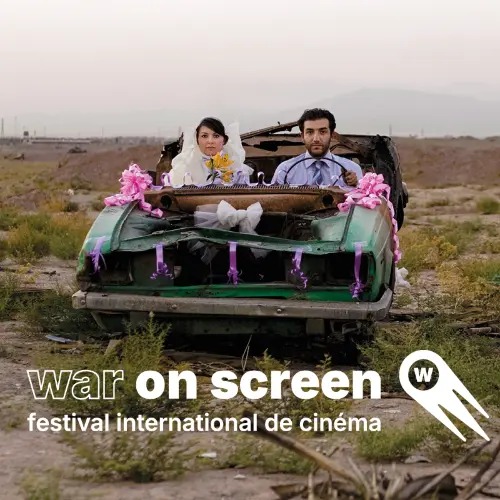
On Wednesday, October 7, 2026, we headed to La Comète in Châlons-en-Champagne to discover War On Screen, an international film festival dedicated to the many ways conflict is portrayed on screen.
Founded in 2013, the festival takes place every year in early October, running for a full week. Its 14th edition, held from October 5 to 11, brought together more than 20,000 filmgoers, as it does each year. Screenings are also an opportunity for audiences to engage with the films beyond the screen, with Q&As and discussions following each showing.
Before experiencing a screening of Roya (2026), directed by Mahnaz Mohammadi, we sat down with Renaud Besse-Bourdier, one of the festival’s programmers. With a background spanning screenwriting, film criticism and teaching, as well as a deep knowledge of cinema, he gave us an insight into his career and the work that goes into shaping this year’s programme.
A Career Shaped by a Love of Cinema
After studying at the École Normale Supérieure (ENS) and at the University of Chicago, Renaud began his career as an English teacher. He later qualified to teach cinema as both an elective and a specialist subject at high school level.
Alongside teaching, he writes plays for the theatre troupe Les Wonderbiches, works as a screenwriter in animation and contributes film criticism to established publications.
It was through his work as a critic, particularly as editor-in-chief of Cinématraque and a contributor to Écran Large, that he first crossed paths with War On Screen. When a member of the programming team left the festival the previous year, the organisers invited recommendations from existing programmers and received around ten potential candidates. Renaud was among those selected to join the team.
For him, programming is about more than simply choosing good films. It means approaching cinema with genuine curiosity and finding ways for different works to resonate.
How a Festival Programme Comes Together
Brainstorming kicks off as early as January with initial planning sessions. Renaud explained that things really accelerate in February once the lineup for the Clermont-Ferrand Short Film Festival is unveiled. This marks the start of an intense scouting and screening process, with the team watching both new releases and older works.
When it comes to short films and thematic spotlights, Renaud and Antoine Desrues watch about a hundred movies to select just fourteen—ten for the official competition and four out of competition. For feature films, Hervé Bougon leads the selection process, while youth programming is placed in the capable hands of Mathilde Boureau. To track down the best titles, the programmers scout major international festivals like Cannes and Berlin.
This entire operation is steered by Édouard Chapot, Director of La Comète, and anchored by central coordinator Julie Maillard—without whom, as Renaud noted, “nothing would work.” In the end, all final decisions are made collaboratively, with every film debated to build meaningful connections across the program.
Three Themes at the Heart of This Year’s Programme
Each year, War On Screen builds its programme around three main thematic strands.
The first explores animal rights. Following previous editions’ focus on environmental issues, this year’s selection turns to the violence humans inflict on animals and the ways cinema confronts it. The films range from the unsettling experimental work Gorge Cœur Ventre, filmed inside a slaughterhouse, to family-friendly animation such as Happy Feet. The contrast between the two offers different ways of approaching the same questions.
The second strand explores submarine films, a genre that offers rich possibilities for exploring suspense, editing and the power of suggestion, including through the Kuleshov effect. The selection brings together lesser-known gems from French cinema, such as Les Maudits, which follows civilians fleeing Nazi Germany, alongside Hollywood classics and Cold War thrillers. Among them are The Enemy Below and The Hunt for Red October, the latter screened in 35mm, as well as the essential submarine-war film Das Boot.
The third strand focuses on Taiwan, a subject particularly close to Renaud’s heart. Through this selection, the festival examines the geopolitical pressures facing the island and the competing forms of Japanese, Chinese and Western imperialism that have shaped its history. In many of these films, war remains in the background rather than taking centre stage, yet its presence is never far away. By revisiting Taiwan’s New Wave cinema of the 1980s and highlighting influential filmmakers such as Edward Yang, the programme also makes a broader point: a territory’s cultural identity can endure and gain recognition even when its political status remains contested.
When Cinema Meets Current Affairs
One of War On Screen’s defining strengths is its ability to connect the conflicts of the past with today’s headlining issues. Documentaries addressing Palestine and Ukraine, films exploring the situation in Lebanon, and works piecing together Iran’s history through family archives all reflect the festival’s commitment to confronting difficult realities head-on.
There is little room here for comfortable detachment or claims of neutrality. Instead, the programme invites audiences to engage with the political and human dimensions of conflict, both past and present.
The opening film, Le Faux Soir, tells the story of Belgian journalists who struck back against Nazi collaboration by hijacking a collaborationist newspaper and publishing a satirical edition in its place. Their act of resistance feels strikingly relevant today, drawing a line between the fight against wartime propaganda and the ongoing struggle against disinformation and fake news.
Other films take a different approach. Notre salut, for instance, examines the persistent links between capitalist management practices and fascist structures. Blurring the boundaries between documentary and improvisation, the film uses a style reminiscent of The Office to explore a subject that is anything but light-hearted.
Together, these works show how cinema can do more than revisit history: it can help us make sense of the world we live in now.
Renaud’s Must Watch
When we asked Renaud which films had particularly caught his attention this year, he singled out two works that he believes deserve a place on every film lover’s watchlist.
His feature-film pick is Edward Yang’s Yi Yi, widely regarded as a masterpiece of Taiwanese cinema and one of the great works of film history.
For short films, he chose Felipe Casanova’s O Rio de Janeiro Continua Lindo, a deeply affecting story about a mother writing to her son after he becomes a victim of police violence during Carnival. One line from the film, in particular, stayed with Renaud: “I can still feel joy when I find pieces of you in other people.”
One Last Piece of Advice
We ended our conversation by asking Renaud about the role of audiences and the place of younger generations in today’s cultural landscape. He said:
“Stay curious, and don’t be afraid to think critically. A few decades ago, the media devoted a significant amount of space to criticism. Today, there is barely any left. That is a serious problem, because critical thinking teaches us so much about who we are, as human beings, as members of society and as political beings. We need these kinds of discussions to become better citizens and to learn how to treat one another better. So question what you watch, think about why you like or dislike something, and talk about it with others.”
And, before we parted ways, he had one final recommendation to share: “And that’s it—go watch Godzilla movies, because they’re great!”
We then headed straight into a screening of Roya, and it proved to be a fitting end to our day at the festival. With director Mahnaz Mohammadi in attendance, the film left all four of us deeply moved. It was a powerful experience that stayed with us long after the screening ended.